Add Your Heading Text Here
When Response Overrides Intention: The Influence of Subconscious Conditioning
When your response doesn’t match your intention
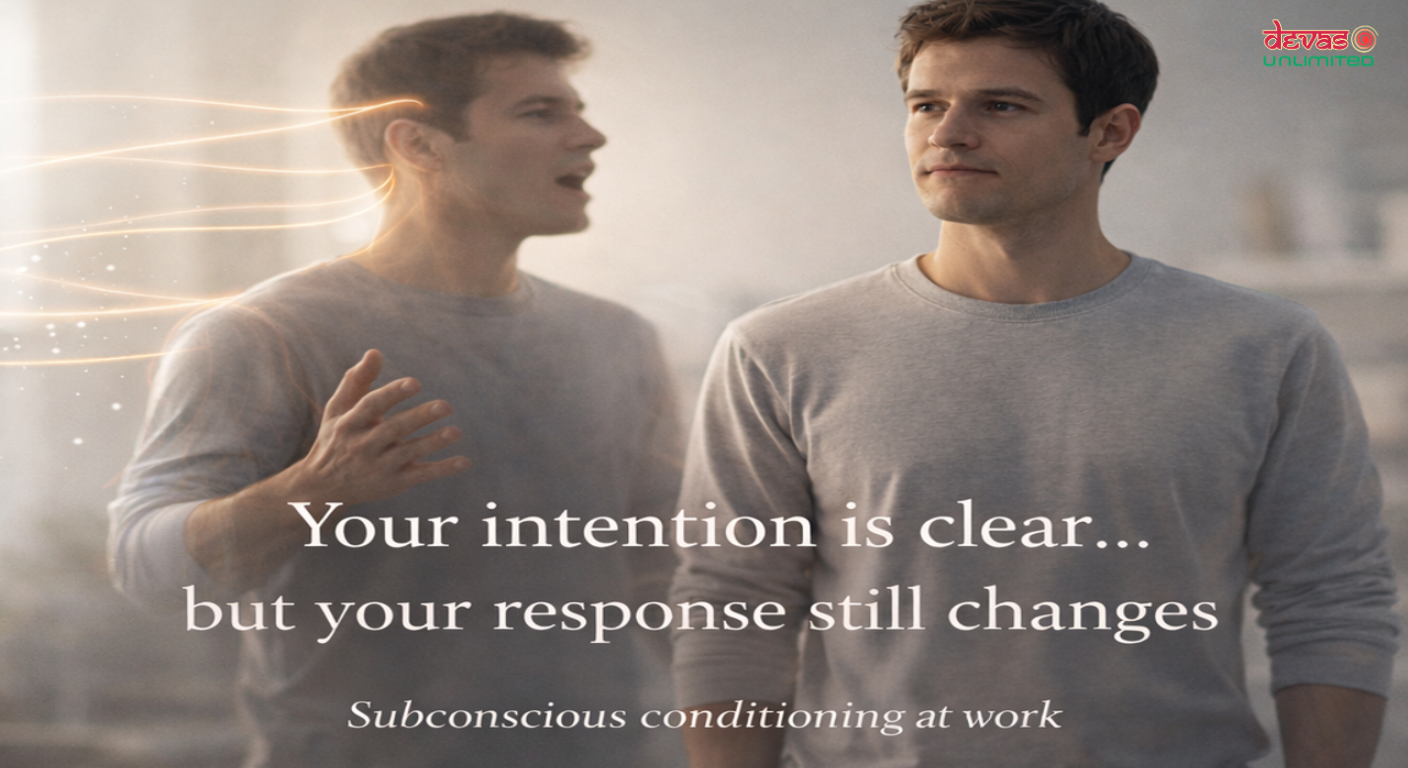
Subconscious conditioning often causes your response to override your intention, even when you clearly know how you want to act.
There are situations where your intention is clear, but your response does not follow it.
You may decide to stay calm, speak clearly, or handle something differently. In that moment, you know exactly how you want to respond.
Yet when the situation arises, your reaction takes a different direction.
You may respond quickly, feel triggered, or say something you did not intend to. Later, when you reflect on it, the gap becomes obvious.
This is not about lack of clarity.
It is about something overriding your intention in that moment.
The gap between deciding and doing
Most people assume that once a decision is made, the response will naturally follow.
But there is often a gap between:
- what you decide
- and how you actually respond
You may have already processed the situation and understood it. You may even feel confident that next time will be different.
However, in the actual moment, the response does not come from that decision. It comes from what is already active within you—and this is where subconscious conditioning plays a role.
What drives responses in the moment

Not all responses are created consciously.
Some are shaped through repeated experiences and reinforced over time. These form a layer of subconscious conditioning that operates automatically.
This conditioning can develop through:
- repeated emotional experiences
- fear-based situations
- habits formed over time
- environments that required certain responses
Once established, these responses do not wait for conscious direction. They get activated when a similar situation appears.
That is why your response may feel immediate and difficult to change in the moment.
Why intention is not enough
When you set an intention, it exists at a conscious level.
But when a situation triggers a deeper response, the reaction comes from a different level—often driven by subconscious conditioning.
This is why you may notice:
- reacting before you can pause
- feeling pulled into a familiar emotional state
- responding in ways you had already decided to change
It is not that your intention is weak.
It is that the response is being driven by something that was already formed and reinforced over time.
How subconscious conditioning maintains control
Over time, repeated responses become the default.
Even when you no longer want them, they continue because they have been practiced and reinforced. This is how subconscious conditioning maintains control over your reactions.
This creates a pattern where:
- the same triggers lead to the same reactions
- the response feels automatic
- change feels difficult despite effort
At this stage, the response is no longer a conscious choice. It is a conditioned reaction.
Why trying harder does not resolve it
When you notice this gap, the natural response is to try harder.
You may attempt to:
- control your reactions
- stay more alert in triggering situations
- consciously override your response
While this can create temporary change, it often does not last.
Because the response is not being created in that moment – it is being triggered from what already exists through subconscious conditioning.
Until that conditioning is addressed, the same reaction tends to return.
Working at the level of conditioning
If the response is coming from conditioning, it needs to be worked with at that level.
This is where a structured approach becomes important.
Instead of focusing only on the response, the focus shifts to:
- identifying the conditioning behind it
- working with it at a deeper level
- gradually reducing its influence
This is the basis of approaches like Cutting the Ties That Bind (CTTB), where symbolic processes are used to work directly with subconscious conditioning.
What begins to change
When the influence of conditioning starts to reduce, the shift is gradual but noticeable.
You may begin to observe:
- a pause before reacting
- less intensity in familiar situations
- greater control without effort
- responses that align more closely with your intention
The change does not come from forcing a new response.
It comes from the old response losing its hold.
A Next Step
If you have noticed that your responses don’t always align with your intention, it may not be something that changes through effort alone.
The ✨ CTTB Foundation Course 2 is a structured 2-session program designed to help you work directly with these subconscious influences through symbolic practice, so their hold gradually reduces.
🗓️ April 19 & May 17
⚠️ Open only to those who have completed Primary & Major Relationship Cuts
👉 You can register to begin working with this more directly
Key Takeaways
- There can be a gap between intention and response
- Some reactions are driven by subconscious conditioning
- These responses are formed through repeated experiences
- Effort alone may not change conditioned reactions
- Change begins when the underlying conditioning is addressed