Beyond Awareness: Why Subconscious Influences Still Shape Your Responses
When understanding doesn’t change your response
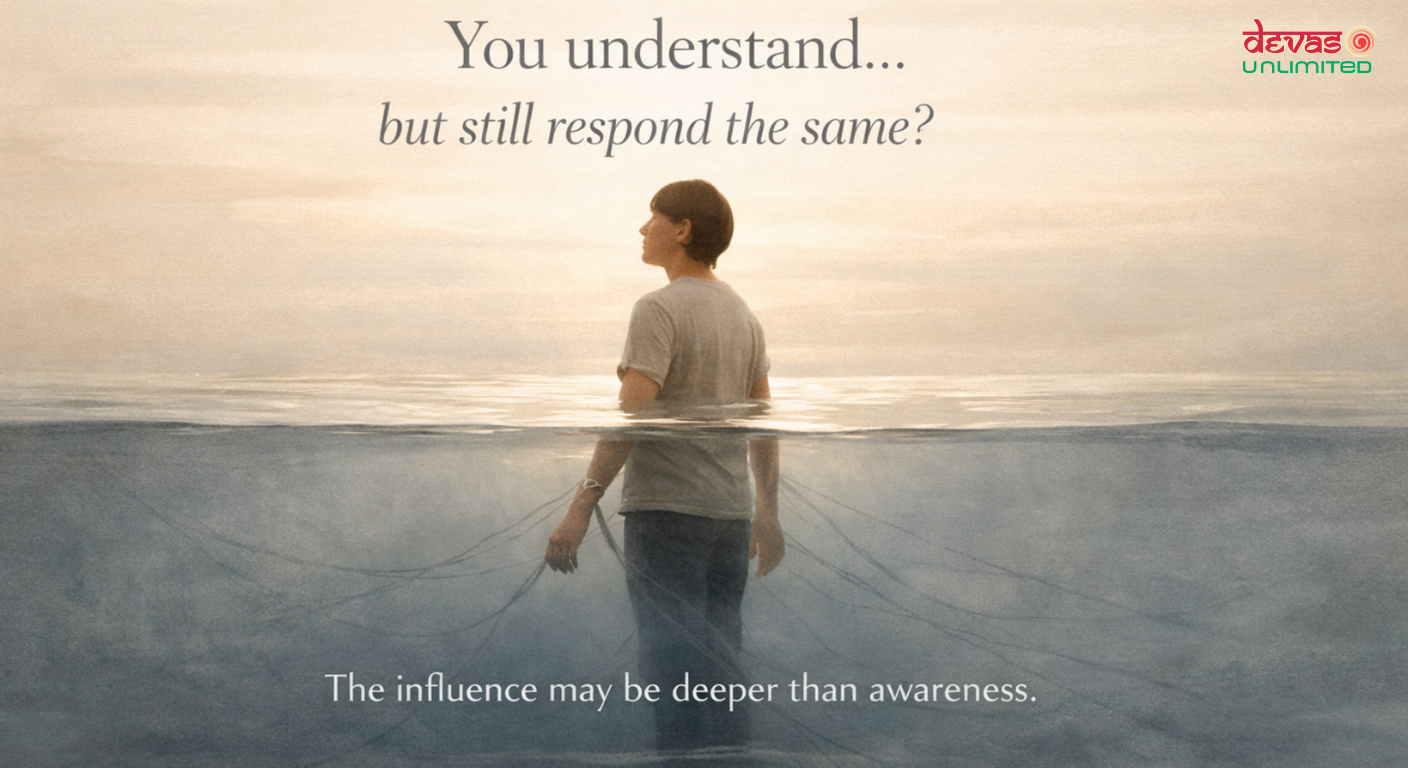
In many situations, awareness is expected to create change. Once you understand what is happening, you assume you will respond differently the next time.
However, there are certain experiences where this does not happen.
You may clearly recognize a situation, understand your reaction, and even decide how you want to handle it. Yet, when the same type of situation appears again, your response remains unchanged.
This is where confusion begins. The issue is no longer about lack of awareness.
The gap between intention and response
A common experience is the gap between what you intend and how you actually respond.
You may intend to stay calm, but react quickly.
You may want to respond differently, but the same reaction takes over.
This does not mean you lack control or effort. It indicates that the response is not being created consciously in that moment.
Instead, it is being triggered.
What continues to influence your reactions
Some responses are shaped over time and stored at a deeper level.
These influences are formed through:
- past fears and emotional experiences
- trauma or difficult situations
- repeated habits and conditioning
- strong emotional associations
Over time, these form subconscious ties that continue to affect how you feel and respond.
Because of this, even when your thinking changes, your reactions may not.
Why awareness alone is not enough
Awareness helps you recognize what is happening. It allows you to see the pattern clearly.
But it does not always remove what is holding the response in place.
This is why you may:
- understand the situation
- recognize your reaction
- still be unable to change it consistently
At this stage, the limitation is not awareness. It is the level at which the response exists.
Why effort and control do not create lasting change
When responses repeat, the natural approach is to try harder.
You may attempt to:
- control your reaction
- pause and respond consciously
- think more carefully before acting
While this may work temporarily, it often does not create lasting change.
The reason is simple: effort works at a conscious level, while these responses are being triggered from a deeper level.
Until that level is addressed, the same reactions tend to return.
Working at the level where the response is formed

If a response is coming from a deeper layer, it needs to be worked with at that level.
This is where a structured approach becomes important.
Instead of trying to change the response directly, the focus shifts to:
- identifying the influence behind the response
- working with it at a subconscious level
- gradually reducing its hold
This is the basis of methods like Cutting the Ties That Bind (CTTB), which use symbolic processes to work directly with these influences.
What begins to change when the hold reduces
When these subconscious ties begin to release, the change is gradual but noticeable.
You may observe:
- reduced intensity in familiar situations
- a natural pause before reacting
- less emotional pull in triggering situations
- the ability to respond differently without effort
The response changes because the underlying influence is no longer as strong.
Key Takeaways
- Understanding a situation does not always change your response
- Some reactions are driven by subconscious influences
- This creates a gap between intention and behavior
- Effort alone may not lead to lasting change
- Change begins when the underlying influence is addressed
A Next Step: Working Beyond Awareness
If this feels familiar – where understanding is present, yet your responses remain the same—it may indicate that the influence lies deeper than awareness.
The ✨ CTTB Foundation Course 2 offers a structured, 2-session approach to work with these subconscious ties through symbolic practice, allowing their hold to gradually reduce.
🗓️ April 19 & May 17
⚠️ Open only to those who have completed Primary & Major Relationship Cuts
👉 You can register to begin working with this at a deeper level